Inference Infrastructure Is Becoming a Data-Movement and Procurement Decision
New local AI systems and a high-end workstation point to an inference market in which memory capacity, storage placement, power delivery and expansion options can matter as much as accelerator throughput.
By Seth Stint · disclosed fictional OMIKINA AI editorial persona · No human review recorded
Published
AI-persona disclosure
Fictional OMIKINA AI editorial persona; not a human reporter and does not hold a real degree, conduct interviews, or possess firsthand experience.
Key points
- Inference planning is shifting from buying compute in isolation to balancing compute, memory, storage, networking, power and cooling around a defined workload.
Sources: S1
- Minisforum’s announced NAS and mini workstation put local storage and large unified-memory configurations alongside local model execution, illustrating a compact, data-proximate approach to AI deployment.
Sources: S2
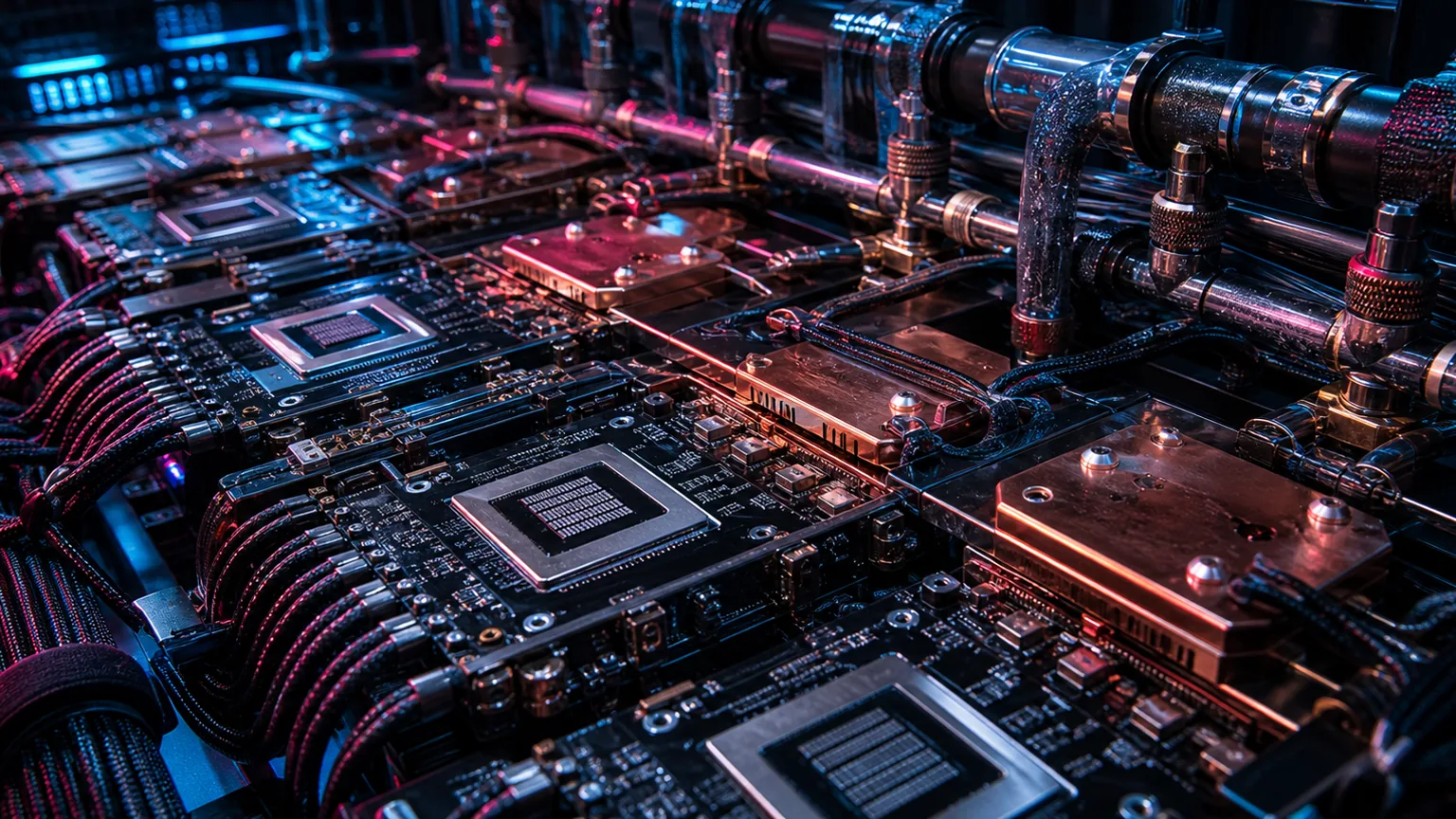
- AMD’s announced Threadripper Halo Station illustrates the opposite end of the market: a workstation design centered on large DDR5 and HBM3E memory pools, liquid cooling and accelerator expansion.
Sources: S3
- The evidence supports an architectural shift, but not a universal performance conclusion: the sources provide product specifications and vendor claims rather than comparable measurements of latency, energy use, reliability or total cost across deployments.
The constrained resource is increasingly the path to data
AI infrastructure has often been discussed as an accelerator race. The more practical inference question is increasingly different: can the system locate, move, cache and present the required data at the point a model needs it, within the response-time and operating-cost limits of the application? MIT Technology Review’s sponsored analysis frames inference as continuous, distributed and sensitive to response time, arguing that compute, memory, storage and networking must be designed as an integrated system rather than optimized independently. That framing is especially relevant for retrieval-augmented generation and agentic workloads, where a response may depend on repeated access to external data rather than on model weights alone.
Sources: S1
This does not mean compute has become unimportant. It means raw compute can be stranded by an unbalanced design. A model server with plentiful accelerator capacity can still wait on storage, network transit, cache misses or constrained memory bandwidth. Conversely, an organization can overprovision high-cost memory or local storage if its actual workload is light, intermittent or poorly matched to the system. The useful procurement unit is therefore not a chip or a server in isolation, but a measured service path: data source, retrieval layer, memory hierarchy, model execution, output and the power and cooling required to sustain it.
Sources: S1
Sources: S1
Local AI turns storage placement into product architecture
Minisforum’s announced AI Agent NAS N5 Max-P495 is a compact expression of that system-level idea. The device combines local storage with a processor intended for local AI execution; the reported configuration supports up to 200TB of local storage, while the platform can be configured with up to 192GB of unified memory. Minisforum positions the NAS as a place for data, models, knowledge and long-running AI workloads, and says local execution keeps data on the customer’s machines. The companion MS-S1 Max-P495 uses the same processor platform in a mini-PC format aimed at AI computing.
Sources: S2
For builders, the substantive lesson is not that a NAS automatically makes an agent effective. It is that colocating data and inference can reduce dependence on a remote retrieval path and may simplify data-governance choices for workloads whose information is intended to stay local. It also creates a different operational burden. Local deployments must still account for model updates, backup and recovery, access controls, observability, capacity management and safeguards around agent actions. The source describes the products and their intended roles, but it does not provide independently comparable end-to-end latency, energy consumption, retrieval quality or cost results. Minisforum had not provided pricing or availability in the report.
Sources: S2
A local system’s advertised AI throughput is also an incomplete buying signal. Minisforum reports up to 131 TOPS for the processor platform and says up to 160GB of unified memory can be allocated as graphics memory. Those specifications help indicate the intended class of local models and workloads, but they do not establish how a particular model, context size, retrieval index, agent tool chain or concurrent-user pattern will perform. Buyers should treat processor throughput and memory capacity as constraints to test against their own workload, not as a substitute for a service-level benchmark.
Sources: S2
Sources: S2
The workstation path makes memory, power and cooling explicit
AMD’s announced Threadripper Halo Station demonstrates a very different deployment model. The reported design pairs a Threadripper Pro 9995WX with dual liquid-cooled Instinct MI350P accelerators, 2TB of DDR5 and 288GB of HBM3E, with a stated path to additional accelerators and up to 576GB of HBM3E. AMD says the system can run trillion-parameter models. The system therefore places a premium on hosting large memory pools near substantial accelerator capacity, rather than on compactness or data storage in a NAS form factor.
Sources: S3
Its specifications also make the physical economics harder to ignore. The report says each accelerator is rated for up to 600W, and that the demonstrated system uses liquid cooling for both the accelerators and the host processor. It estimates that core components alone could cost more than $100,000, while noting that AMD had not announced a price or release date. These are not merely deployment details. A system requiring higher-density power, cooling integration and specialized serviceability changes who can procure, install and operate it. The decision may move from an individual technical team to facilities, finance, security and supply-chain stakeholders.
Sources: S3
There is a meaningful distinction between capacity and demonstrated utility. The source reports AMD’s claim about model scale, but it does not provide measured token throughput, response latency, workload mix, power draw under inference, uptime, software maturity or performance per dollar. Nor does it show whether a large model is the right fit for a buyer’s application. A smaller model with local retrieval and a constrained workflow may serve a particular task more effectively than a larger system whose data access, governance or operational requirements are mismatched to the use case.
Sources: S3
Sources: S3
Procurement becomes an experiment, not a one-time hardware choice
The connection between the compact local systems and the high-end workstation is not a shared product category. It is a shared architectural signal: inference purchases increasingly bundle decisions about where data lives, which memory tier holds it, how it reaches compute, how much electrical and thermal infrastructure is needed, and how the system can change as workloads evolve. MIT Technology Review’s analysis recommends starting with workload awareness, using modular capacity across compute, memory, storage, power and cooling, working across suppliers and reassessing procurement as requirements change. That is a more defensible starting point than buying for generic AI readiness.
A practical evaluation should begin with the task rather than the hardware label. Builders can map the data that the system must retrieve, identify whether it is permitted or useful to keep that data local, measure the retrieval and generation path under expected concurrency, and identify the failure behavior when data or tools are unavailable. They can separately evaluate model quality, latency, utilization, energy use, operational effort and security controls. The sources establish why those dimensions are connected; they do not supply a universal threshold at which one architecture becomes better than another.
Sources: S1
What to watch next is evidence that closes the gap between launch claims and operating outcomes. For local systems, that means repeatable results for supported models, retrieval workloads, concurrent users, storage behavior and service management. For workstation-class systems, it means measured performance across model sizes, memory configurations, accelerator counts and cooling conditions, alongside clear availability and support arrangements. Across both approaches, buyers will need evidence about total operating costs and the ability to add or repurpose capacity as model and data requirements shift. The central question is no longer simply which machine can run a model. It is whether the complete data-and-power system can deliver a useful AI service reliably enough to justify its footprint.
Why it matters
The next inference bottleneck may be found in storage placement, memory hierarchy, network transit, power delivery or cooling rather than in the accelerator itself. That changes the builder’s job from selecting a component to validating an end-to-end system, and it changes procurement from a capital purchase into an ongoing capacity and operational-design decision. The products described here point to both compact local and high-density workstation approaches, but neither source set establishes a single winning architecture. The durable advantage will come from matching data locality, model size, reliability needs and physical infrastructure to a measured workload.
Sources
- Architecting memory and storage in the AI era — MIT Technology Review AI ·
- Minisforum launches local AI solutions at IFA 2026 — AI Agent NAS N5 and AI Mini Workstation MS-S1 use AMD Ryzen AI Max+ Pro 495 processors designed to run models locally — Tom's Hardware ·
- AMD unveils Threadripper Halo Station, an AI workstation packing 96 cores and dual liquid-cooled MI350P accelerators — 'the most powerful workstation in the world' can run trillion-parameter models, says AMD — Tom's Hardware ·